
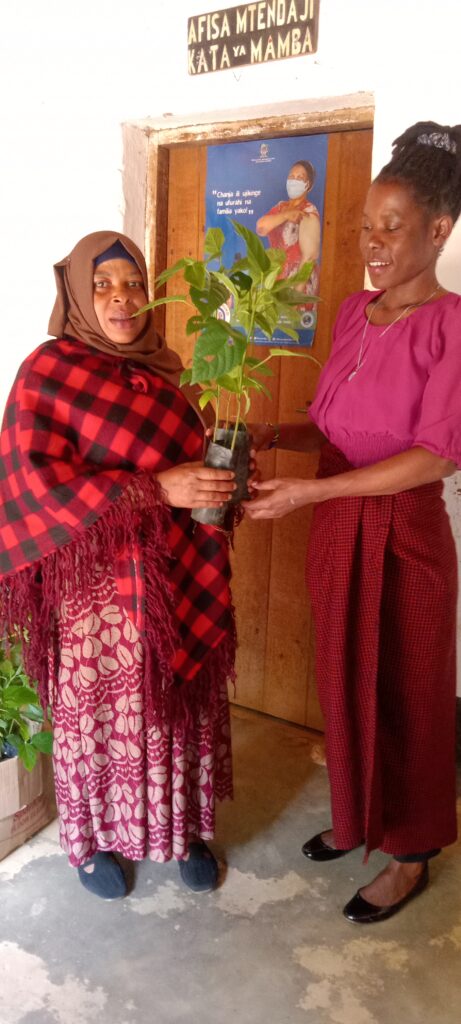
Toward the end of World Water Month, on the 28th, of March, 2024. On behalf of the organization SEPA, Aneth Ndyetabula handed 43 wild fig tree saplings to the Mbelei village’s executive officer on behalf of the Mamba ward’s executive officer at the office of the Mamba ward. The executive officer received them with a thankful heart promising to be a champion of SEPA efforts to ensure environmental sustainability in the Bumbuli District Council. The trees were then distributed to all villages of Mamba ward ( Kwadoe, Kwalei, Kwekitui, and Mbelei). They were planted in areas adjacent to the water sources of the mentioned villages.
We can not talk about water security without mentioning planting trees and water sources protection and conservation. Trees are a major part of the hydrological cycle (water cycle) through transpiration process. Apart from that water friendly trees like wild fig trees play a vital role in water security including;
Wild fig trees help improve water retention in the soil. Their root systems create a network that holds soil together, reducing runoff and allowing more water to seep into the ground.
Enhance soil fertility, the fallen leaves of wild fig trees decompose and release nutrients into the soil, which can improve its fertility. This is particularly beneficial near water sources where soil quality is crucial for the health of aquatic ecosystems.
The deep roots of wild fig trees help prevent soil erosion, which is especially important near water bodies that can be affected by erosion from runoff. By stabilizing the soil, fig trees can maintain the integrity of riverbanks and shorelines. Also, planting fig trees near water sources can support local biodiversity.
They provide habitat and food for various species, which can be particularly important in riparian zones where trees can create corridors for wildlife. Trees planted along rivers, like fig trees, can absorb extra water and mitigate flooding. They can intercept heavy rainfall, reducing the speed at which surface runoff reaches the river, thus helping to manage flood risks.
Lastly, trees can influence the local microclimate, providing shade and reducing temperatures. This can be beneficial for both terrestrial and aquatic species, as cooler water temperatures are often crucial for the survival of many aquatic organisms.
Wild fig trees and other water-friendly trees are very crucial for water security.